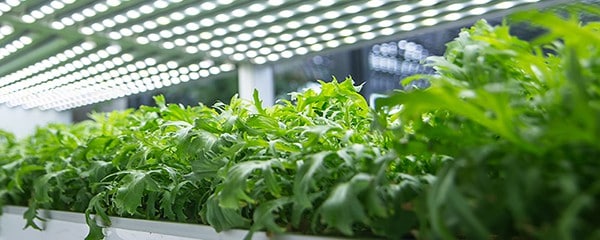
A grow light qualifies for most utility rebate programs only if it appears on the DesignLights Consortium Qualified Products List, and since April 18, 2025 that has meant clearing a minimum photosynthetic photon efficacy of 2.5 micromoles per joule. A fixture that misses the threshold does not get a smaller rebate. It gets nothing.
That single line item decides more rebate outcomes than anything else in the application. Operators pick a fixture on price, spec sheet, or a rep's word, sign the purchase order, and only then find out the model was never listed — or was listed under a version of the requirements that has since expired. The equipment still works. The rebate is simply gone.
What Is the DLC Qualified Products List?
The Qualified Products List is a public database of lighting products that have passed the DesignLights Consortium's testing and performance requirements. The DesignLights Consortium is a nonprofit that sets efficiency standards utilities use to decide which equipment earns incentive money. Horticultural fixtures sit on their own list, separate from commercial lighting.
The DesignLights Consortium does not manufacture, sell, or install anything. It writes the technical requirements, accredits the labs that test against them, and publishes the results. Utilities across the United States and Canada then point their rebate programs at that list rather than each writing their own equipment standard. It is administrative infrastructure, and it is the reason a rebate program in Massachusetts and one in Michigan can agree on what counts as an efficient fixture.
For a cultivator, the practical meaning is narrow and worth stating plainly: the list is a yes-or-no gate that sits in front of the money.
Why Do Utilities Require DLC Listing?
Utilities pay rebates out of ratepayer-funded efficiency budgets and have to document the energy they actually saved. Third-party listing gives them verified performance data without testing every fixture themselves. It also protects the program from paying for equipment that underdelivers, which is why the requirement is rarely waived.
The savings at stake are real. The U.S. Department of Energy modeled the effect of converting horticultural lighting across the country to light-emitting diode technology and put the reduction at 34 percent of site electricity, roughly $350 million a year.
34% — Site electricity reduction the U.S. Department of Energy modeled for converting U.S. horticultural lighting to LED, about $350 million annually.
Source: U.S. Department of Energy, Energy Savings Potential of SSL in Agricultural Applications (2020).
A utility running a rebate program is buying a slice of that reduction. The listing requirement is how it makes sure the slice is real before the check goes out.
What Does a Fixture Have to Prove?
A horticultural fixture has to prove efficiency and durability together. Under the current requirements it must hit 2.5 micromoles per joule of photosynthetic photon efficacy, carry a warranty of at least five years, and demonstrate that its driver, its cooling fans, and its photon output hold up over rated hours of operation.
Photosynthetic photon efficacy, or PPE, measures how much usable light a fixture produces per unit of electricity, in micromoles per joule. It is the horticultural equivalent of lumens per watt, and it is the number the entire listing turns on.
| Requirement | Threshold |
|---|---|
| Photosynthetic photon efficacy | 2.5 micromoles per joule, less a 5 percent test tolerance |
| Warranty | Not less than five years, covering all components |
| Driver rated life | 50,000 hours or greater at maximum rated ambient temperature |
| Cooling fan rated life | 50,000 hours or greater at maximum rated ambient temperature |
| Photon flux maintenance (Q90) | 36,000 hours or greater, 400 to 700 nanometers |
| Safety certification | ANSI/UL 8800, via an OSHA-recognized NRTL or an SCC-recognized body in Canada |
The durability thresholds matter more than growers expect. A sole-source room running 12 or 18 hours a day burns through rated fan life faster than an office building burns through a driver, and a fixture that fails in year three turns a funded upgrade into an unfunded replacement. The five-year warranty floor exists for that reason.
What Changed With Version 4.0 in 2025?
Version 4.0 raised the minimum photosynthetic photon efficacy to 2.5 micromoles per joule, with a 5 percent test tolerance that puts the effective floor at 2.38. The DesignLights Consortium began accepting Version 4.0 applications on April 18, 2025, and delisted Version 3.0 products on January 5, 2026.
This is the change that catches people in 2026. A fixture that was legitimately DLC-listed in 2024 may no longer be on the list today, and a spec sheet printed two years ago is not evidence of anything. Distributor inventory turns slower than the requirements do, which means warehouses still hold stock that was qualified when it shipped from the factory and is not qualified now.
Utility programs adopt new versions on their own schedules, which adds a second date to track. Energy Trust of Oregon has required Version 4.0 for its lighting incentives since July 1, 2026. Your utility may have moved earlier, later, or not yet at all, so confirm which version your program accepts before you order anything.
Before you sign a purchase order
Check the listing on the day you buy, not the day you got the quote. Confirm the exact model number and the exact wattage variant — manufacturers list families of fixtures, and it is common for one variant in a family to qualify while its neighbor does not.
Then confirm your utility's program is pointed at the current version of the requirements. Most are, but program manuals update on their own schedule.
How Do You Check If a Fixture Qualifies?
Search the Qualified Products List directly at designlights.org by manufacturer and model number, then match the result against the exact variant you intend to buy. Do not rely on a manufacturer claiming to be DLC-listed. Confirm the specific model appears, and record the date you checked.
- Get the exact model number. Not the product family name. The full model string including wattage and voltage variant, as it appears on the fixture label or the manufacturer's cut sheet.
- Search the horticultural list. Use the horticultural Qualified Products List specifically, not the commercial solid-state lighting list. They are separate databases with separate requirements.
- Screenshot the result. Save the listing page with the date visible. Utilities routinely ask for proof of listing at the time of application, and listings change.
- Verify against your program's version. Confirm your utility accepts the requirements version the fixture is listed under, since programs adopt new versions on their own timelines.
- Apply before you purchase. Nearly every program requires pre-approval. Buying first is the most expensive sequencing mistake in the process.
What If Your Fixture Is Not Listed?
An unlisted fixture is not automatically a dead end, but the path narrows. Some utilities run custom rebate tracks that pay on calculated or measured energy savings rather than on a product list, which can accommodate equipment the prescriptive track will not. Those applications take longer and require engineering documentation.
The other option is the plain one: pick a different fixture. Growers are often more attached to a specific model than the economics justify, and a listed alternative with comparable output can be worth more once the rebate is counted. Whether that trade works out depends on your utility, your rate, and the size of the retrofit, which is the kind of thing worth running the numbers on before committing.
What Rebates handles this check as part of the process, along with the paperwork, the utility coordination, and the equipment procurement. If you want to know where your facility stands before you buy anything, get in touch and we will look at your equipment list and your utility together.
Rebate amounts are determined case by case and depend on your utility, your state's program budget, and the measured energy savings of the specific equipment you install. Nothing on this page is a guarantee of eligibility or payout. Program details and funding levels described here were accurate as of August 2026 and change without notice — verify current terms with your utility or with What Rebates before purchasing equipment.